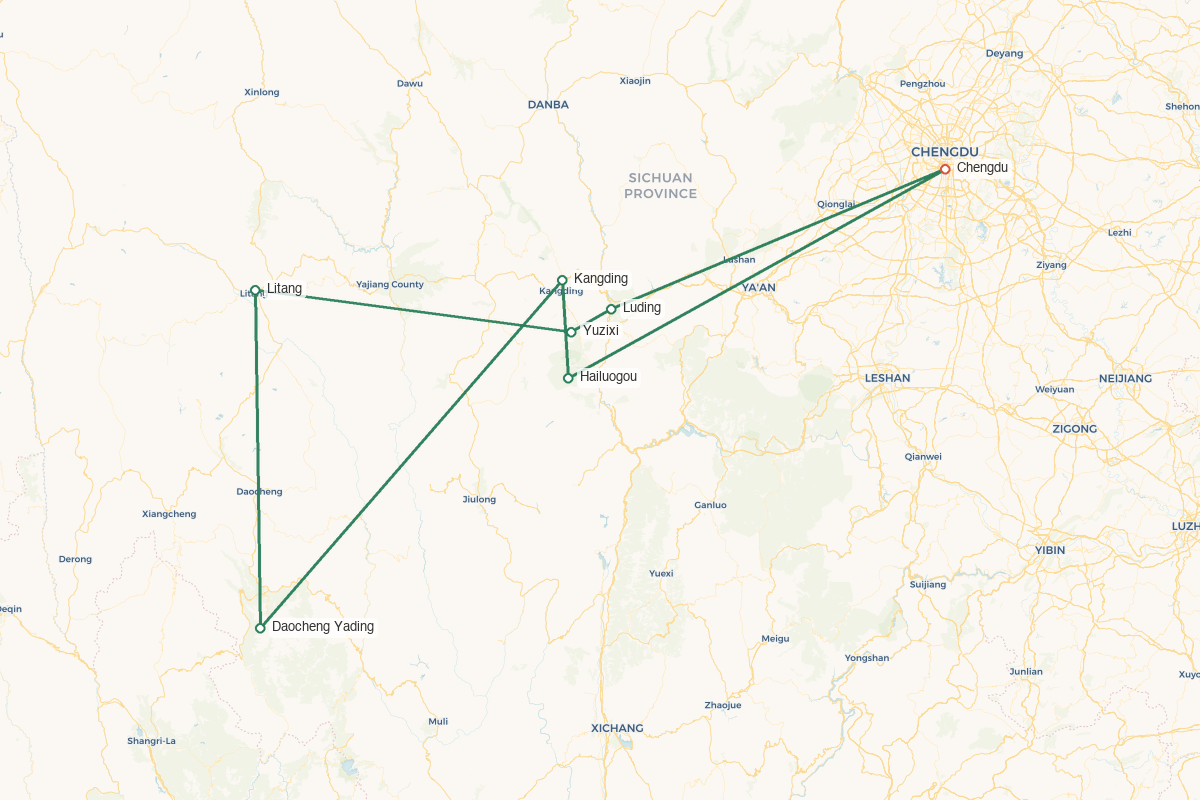
A fast-moving West Sichuan small-group circuit linking mountain passes, Tibetan towns, Litang Monastery, Daocheng Yading, Yuzixi viewpoints, and the glacier landscapes of Hailuogou, with a route strategy that tries to keep overnight stays at relatively lower altitude where possible.
Departure is from a Chengdu collection point, with return to Chengdu around the evening of Day 5. Same-day onward flights or trains are not recommended.
This is a classic West Sichuan overland route rather than a slow luxury retreat. The days are long, the scenery changes constantly, and the reward comes from the arc of the journey itself: deep valleys, high passes, Tibetan settlements, monastery views, Yading’s alpine landscape, and finally the forest-and-glacier scenery of Hailuogou. The small-group format helps the route feel more flexible, but travelers should still expect altitude, early starts, and a road-trip rhythm shaped by mountain conditions.
Depart Chengdu early and head west along the Ya’an–Kangding expressway, crossing the Erlang Mountain tunnel and dropping into the Dadu River gorge — the deepest canyon in western Sichuan, cutting over 2,600 metres from rim to river. A stop at Luding Bridge (*Luding Qiao*), the 103-metre iron-chain suspension bridge where Red Army soldiers famously stormed across under fire in 1935, offers a first taste of the region’s dramatic scale and a pivotal site in modern Chinese history.
Continue to Red Haizi (*Honghaizi*), a high-altitude lake framed by open grassland whose surface shifts between crimson and sapphire depending on the light, before taking the scenic Xinduqiao airport road toward the Yuzixi viewpoint area, where 360-degree views stretch across to the Yala sacred peak and the full Minya Konka (*Gongga*) range — at 7,556 metres the highest summit in Sichuan and one of the most heavily glaciated mountains east of the Himalayas. By evening, arrive in Yajiang (2,200 m) for the first overnight stop, kept deliberately lower than the high passes ahead.
After breakfast, the route climbs over two major passes — Jianziwan Pass (4,659 m) and Kazila Pass (4,718 m), where prayer flags snap in thin air and the horizon opens to an unbroken sweep of grassland — before reaching the high-plateau town of Litang (4,014 m), one of the world’s highest settlements and the birthplace of the seventh and tenth Dalai Lamas. The drive is part of the experience: vast grasslands, changing light, yak herds, and the unmistakable sense of entering a Tibetan cultural landscape.
A stop at Changchun Ke’er Monastery (*Litang Si*), founded in 1580 by the Third Dalai Lama, offers hilltop panoramas over the town and a look inside the largest and oldest Gelug-school monastery in the Kham region, home to over 4,000 monks at its peak. Continue past Rabbit Mountain (*Tuzi Shan*), the ancient glacial boulder field of Haizi Mountain (avg. 4,500 m) — a surreal landscape of granite boulders deposited during the last ice age — and the red-earth river valleys toward Shangri-La Town (*Riwa*) at 2,900 m, where the night is spent before the Yading excursion.
Today is dedicated to Daocheng Yading, the reserve Joseph Rock described in 1928 and the landscape said to have inspired James Hilton’s Lost Horizon — often called the last Shangri-La. After the sightseeing bus crosses Niulang Mountain (4,760 m), arrive at Zhaguanbeng and walk ten minutes to Chonggu Temple (*Chonggusi*, 3,900 m), where meadows, forest, prayer-flag streams, and the sacred peak Xiannairi (6,032 m) — the Bodhisattva of Compassion and the tallest of Yading’s three holy summits — create one of western China’s most dramatic backdrops.
The long route continues by electric shuttle or on foot to Luorong Pasture (4,180 m), a wide alpine meadow ringed by peaks, with views of Xianuoduoji (5,958 m) and Yangmaiyong (5,958 m) — together with Xiannairi, the three sacred peaks that define Yading’s identity and hold deep significance in Tibetan Buddhism. Conditions and fitness permitting, the trail pushes onward to Milk Lake (*Niunai Hai*), a turquoise tarn at 4,500 m, and Five Colour Lake (*Wuse Hai*), whose surface shifts through blues and greens with the angle of the sun. Guests who prefer a lighter day can take the short route from Chonggu Temple to Pearl Lake (*Zhuoma Lacao*), a jewel-green alpine lake reflecting the Xiannairi peak. Return to Shangri-La Town for a second night.
Leave Shangri-La Town and retrace the highland route over Bowa Mountain (4,300 m), passing the red-earth river valleys, Tibetan-style villages with their distinctive whitewashed stone houses and colourful prayer-flag rooflines, and — in season — the Wanmu Qingyang Lin, a vast poplar forest that turns solid gold in September–October and draws photographers from across China. The ancient glacial terrain of Haizi Mountain and the open plateau around Litang provide a different perspective on the return leg, with afternoon light revealing details the morning drive missed.
By evening, arrive in Kangding (2,500 m), the historic gateway between Han and Tibetan China and a tea-trade crossroads for centuries, for the final overnight stop before the glacier section. This is a long road day, but it ties together the wider scale of the West Sichuan landscape and gives the body a lower-altitude rest before the final push.
The final day turns toward Hailuogou Glacier Park near Moxi Town — home to the lowest-altitude maritime glacier in Asia, descending to just 2,850 m where ancient ice meets subtropical forest in a combination found almost nowhere else on Earth. The sightseeing bus climbs through Camp 1 and Camp 2, passing through original forest to Camp 3, where a walking trail or electric cart leads through the glacier rainforest corridor — ancient trees draped in moss, ice-fed streams, the Gongga Sacred Spring with its year-round hot-spring mist, and the Pearl Shoals.
For the strongest views, an optional cable car from Camp 4 (3,600 m) offers an aerial perspective over the glacier-forest boundary — a 1,080-metre ice fall, one of the largest in China — and, on clear days, a direct line of sight to Gongga’s main summit at 7,556 m, the King of Sichuan Mountains. Afterward, begin the long drive back to Chengdu via Luding. Arrival is usually around 8 pm, so an overnight stay in Chengdu is the safest onward plan.